
Deep cut
Tuesday, November 3, 2026
Why Livingston is so windy
If you've driven east over Bozeman Pass in winter, you know the moment. The road drops toward Livingston, the trees thin out, and your hands tighten on the wheel because the truck has started to lean.
If you've driven east over Bozeman Pass in winter, you know the moment. The road drops toward Livingston, the trees thin out, and your hands tighten on the wheel because the truck has started to lean. Folks in Livingston have joked about the wind forever. The National Weather Service in Billings, though, has an actual explanation, and it comes down to where the town sits.
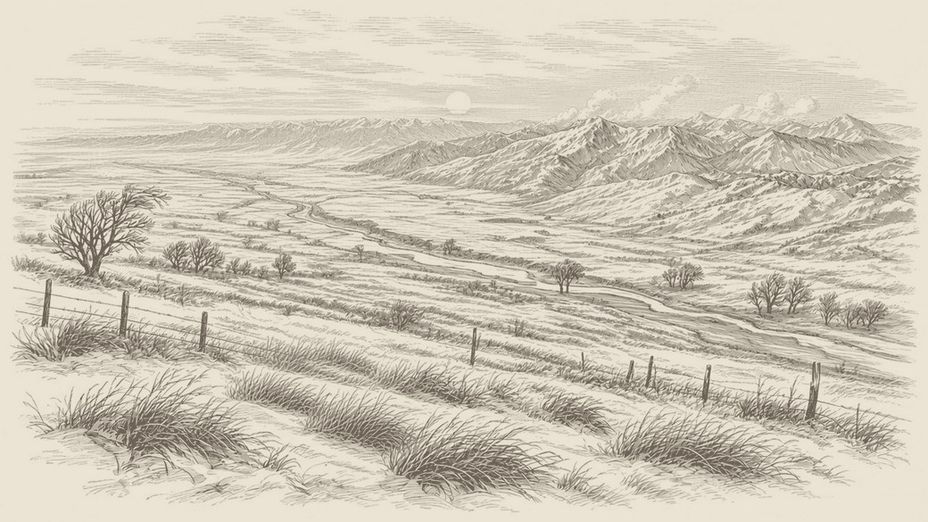
Livingston is at the north end of the Paradise Valley, right where the Yellowstone River comes out of the mountains. The Weather Service calls what happens there a gap wind. It says the strong southwest winds are most common in late fall and winter, so this is the start of the season.
How the Paradise Valley makes wind
The Weather Service explains it in a few steps.
First, cold air builds up in the high country. In the cold months the air over the Yellowstone Plateau gets cold and dense, and that builds a semi-permanent area of high pressure over eastern Idaho and western Wyoming. A 2003 Weather Service technical paper on Livingston winds adds that the air flowing into the Paradise Valley comes from northeast Idaho and Yellowstone, and it stays cold and stable because it's been crossing snow-covered ground.
Next, something has to pull on it. A strong westerly jet stream over the northern Rockies helps form a trough of low pressure on the lee side of the mountains in north-central Montana. With high pressure on one side and low pressure on the other, the air has somewhere it wants to go, and a bigger difference means a stronger wind.
Then a lid holds it in. Warmer air at mountaintop level sits on top of the cold air like a lid, so the cold air can't spill over the ranges. It drains down the valleys instead, and the Paradise Valley is one of them. That 2003 paper says the mountains on each side of the valley rise about 3,000 feet above the valley floor.
Last comes the squeeze. At its north end the valley narrows, and the air gets forced through the opening and speeds up. The Weather Service calls that the venturi effect. Nick Vertz, a warning coordination meteorologist at NWS Billings, wrote in Outside Bozeman that the fastest winds are in the narrow gap just south of town, and that the wind stays local to the immediate Livingston area. The 2003 paper says this draining cold air can push sustained winds over 55 mph at Livingston even when the winds higher up are weak.
The Weather Service lists a couple of other gap-wind spots in Montana, including Nye. Livingston is the one most of us drive through.
The record book
The Weather Service has kept wind records at the Livingston airport, Mission Field, since 1973. The strongest gust on record there is 94 mph, on Dec 21, 1978. In second place is a 92 mph gust at 7:53am on Feb 28, 2024, which the Billings office listed among its top five weather events of that year. That one also brought blowing and drifting snow that affected travel on I-90.
November is already in the top 10. The list has an 86 mph gust on Nov 30, 1992, and an 83 mph gust on Nov 13, 2020. Most of the rest are December and January.
You'll hear bigger numbers than 94 around town, and one local TV report even put the record higher. The airport station's official record is 94, so that's the number we're using.
How often it really blows
The Weather Service says the Mission Field sensor records a peak gust of at least 50 mph on 62 days a year on average, and at least 70 mph on four days a year. Two months of 50 mph days is a lot of trash cans to chase.
The gap shows up in the averages, too. Writing in Outside Bozeman, Vertz put the average December wind speed at 19.9 mph in Livingston and 5.3 mph in Bozeman, about 25 miles west. That's the same month and the same valley, with very different days.
Living with it
The wind is mostly a driving problem. The Weather Service says the crosswinds often hit high-profile vehicles on the interstate, and when there's fresh snow on the ground, blowing and drifting snow can create blizzard conditions even under a clear sky. Vertz wrote that closures sometimes send interstate traffic on a detour through town.
If you're towing a trailer or driving anything tall, check the forecast and MDT's road report before you cross the pass, and slow down through the Livingston stretch. In a car, keep both hands on the wheel and give the semis room. They're getting pushed around harder than you are.
Even Outside Bozeman ran a joke ad next to Vertz's piece, selling rooftop wind turbines to Livingston. That's a pretty good sign of how locals feel about it.
Why it's coming back now
Everything that makes the wind needs cold air sitting over the Yellowstone high country, and that air builds up in late fall. So the windy season starts about now, when the snow starts sticking up high. It's the same geography that gives the Paradise Valley its views, with the mountains close on both sides and the river running out the north end. Livingston gets the view and the wind as a package.
See you at the M.