
Field guide
Friday, October 30, 2026
The one Yellowstone road that stays open all winter
Every fall there's a weekend when somebody at work says they'll "do the park before it closes," and then doesn't. If that was you this year, I have good news.
Every fall there's a weekend when somebody at work says they'll "do the park before it closes," and then doesn't. If that was you this year, I have good news. Sunday, Nov 1, most of Yellowstone closed to regular cars for the winter, and the West, South and East entrances shut with it, according to the park and NBC Montana. One road stays open all year, weather permitting. It runs from the North Entrance at Gardiner to the Northeast Entrance at Silver Gate and Cooke City, and the park calls it the only road generally open year-round to regular vehicles.
So until spring, if you live in the valley and want to see Yellowstone through a windshield, the Gardiner to Cooke City road is the one. Here's what it is, how it's laid out and what to know before you point the car south.
Where the road starts: Gardiner and the North Entrance
The Gardiner end is the one most of us reach first. From the valley you go over the pass to Livingston and then south on US-89 down Paradise Valley to Gardiner. Before you leave town, check the Montana side on MDT's 511 road report (mdt511.com), because the pass makes its own weather in November.
At Gardiner you go through the North Entrance and into the park. Yellowstone charges an entrance fee, so bring your pass or plan to pay at the gate. The current rates are on the park's fees page. I'm not printing a number here, because it's the kind of thing that changes.
Gardiner to Mammoth: the climb to headquarters
From the North Entrance, the road climbs to Mammoth Hot Springs, which is the park's headquarters area. Mammoth is where you'll see the terraces and the old fort buildings, and it's a natural first stop to stretch your legs.
This month the road out of Mammoth has a catch. The park says the Gardner River High Bridge, about half a mile southeast of Mammoth toward Tower Junction, is down to a single lane, 24 hours a day, with delays of up to 15 minutes through Nov 24, 2026. Nothing about it is dramatic. You wait your turn for a bit, so build it into your day and don't plan anything tight on the far end.
Mammoth to Tower Junction: the open middle
Past Mammoth, the road heads east toward Tower Junction across rolling sagebrush country, with long views across the park's northern range. This is the stretch where you start scanning hillsides without meaning to. Keep it slow. The park's speed limit is 45 mph unless a sign says otherwise, and the park warns that winding roads and traffic make drives take longer than people expect.
Tower Junction through Lamar Valley: the reason people come
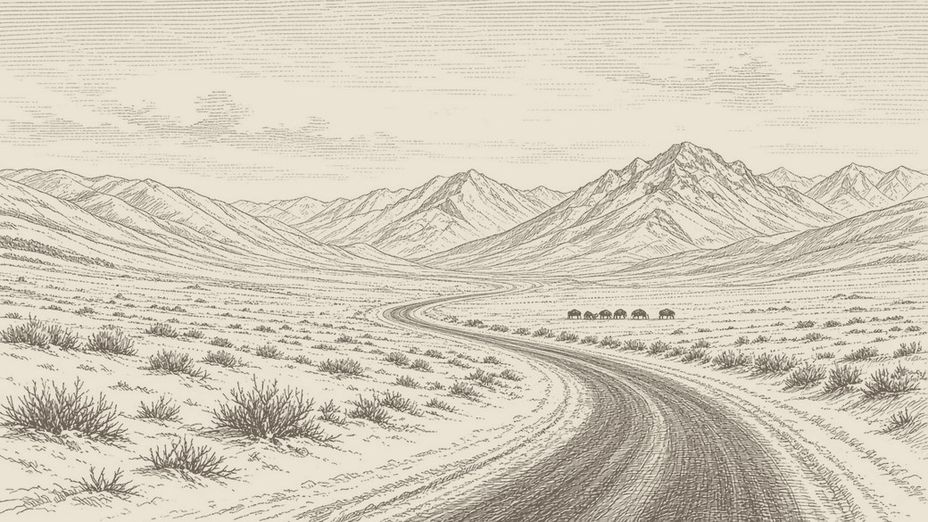
From Tower Junction the road runs through Lamar Valley, which is the wide-open valley people mean when they just say "Lamar." The reason to be on this road in late fall is that you can see a long way from it. People come out with spotting scopes and binoculars hoping to catch wolves on the far slopes. Sometimes they do and sometimes they spend a morning looking at snow, and I'm not going to promise you either one.
If you see a row of parked cars and people with scopes, that's your cue to find a pullout. Don't stop in the lane. The park asks you to use pullouts and get all of your wheels completely off the road, and to stay with your vehicle if you hit a wildlife jam.
The wildlife rules on the Lamar road, straight
This is the one part I won't joke about. The park's rule is to stay at least 100 yards (91 meters) from bears, wolves and cougars, and at least 25 yards (23 meters) from every other animal, bison and elk included. If an animal moves closer to you, the park says to back away and keep that distance. It's also illegal to approach or stay near wildlife at any distance that disturbs the animal.
Bison get their own warning. According to the park, bison have injured more people in Yellowstone than any other animal, and they can run three times faster than you. On this road you will probably sit in a bison jam at some point. When bison are on the road, the park says to be patient, drive slowly and stay in your vehicle. Don't honk, and don't nose the car toward them to hurry them along. They'll move when they move, and getting home is going to take a little longer.
The far end: Silver Gate and Cooke City
The road leaves the park at the Northeast Entrance, and right outside it are Silver Gate and Cooke City. In winter, that's the end of the road for cars. The park says the 9 miles from Cooke City to the Pilot Creek parking area are closed to wheeled vehicles in winter and are open to oversnow travel only. So the Gardiner to Cooke City drive is an out-and-back. You come home the way you went, back through Lamar, Tower Junction and Mammoth to Gardiner.
That turns out to be the best part. The same valley looks different on the drive home, with the light in a different spot and whatever animals moved in the meantime. Park officials say services are limited along the route in winter, and I haven't checked which businesses in Cooke City or Gardiner are open this month. Bring your own food and water and don't count on finding an open spot.
Before you go: the useful bits
Park officials, quoted by NBC Montana, tell winter visitors to carry cold-weather supplies, keep a full gas tank and stay flexible, because roads can close for weather. Here's what I'd save in my phone:
- Yellowstone road status: the park roads page at nps.gov/yell/planyourvisit/parkroads.htm, or call (307) 344-2117 for the recorded line.
- Road alerts by text: text 82190 to 888-777, per the park. You'll get an automatic reply with instructions.
- Current park conditions: nps.gov/yell/planyourvisit/conditions.htm.
- Wildlife and safety rules: nps.gov/yell/planyourvisit/safety.htm.
- Montana roads on the way down: mdt511.com for the pass, I-90 and US-89.
- Fees: nps.gov/yell/planyourvisit/fees.htm.
What changes in December
The rest of the park doesn't stay quiet forever. Most park roads open to commercially guided snowmobiles and snowcoaches from mid-December to mid-March, and the park lists Dec 15, 2026, as the start date for most of those routes. That travel happens on other roads, though. For a regular car, the Gardiner to Cooke City road stays the only way in all winter.
So if you missed the park this fall, you didn't really miss it. Fill the tank, check the road, pack a thermos and give the bison their 25 yards.